

Description
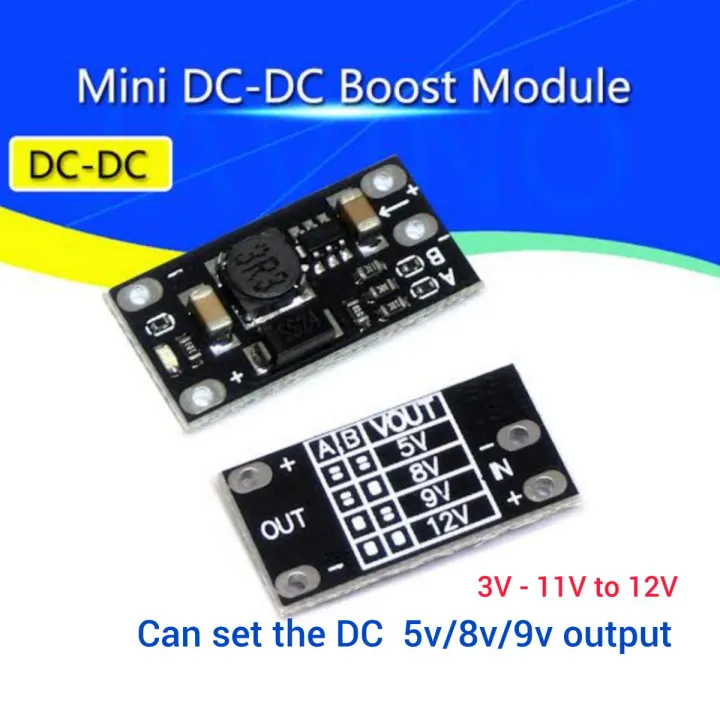
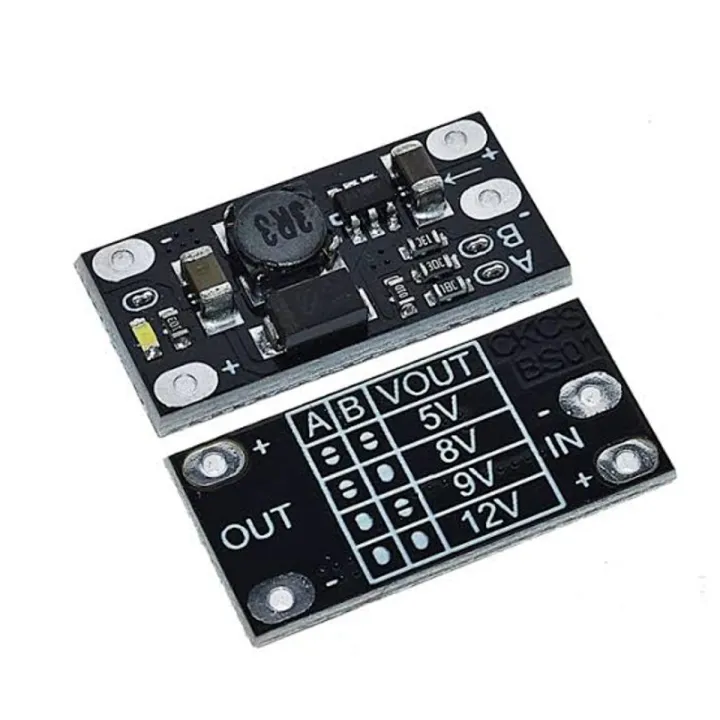
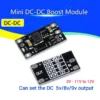
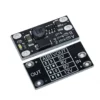
A step-up or “boost” converter module is a compact DC-DC voltage converter that efficiently increases a lower input voltage to a higher output voltage. A black-colored module typically refers to one based on the MT3608 integrated circuit, and its key features are high efficiency, adjustable output, and a small form factor. Description and specifications Function: As a boost converter, its purpose is to “step up” an input voltage from a low-voltage source, such as a single lithium battery or a USB port, to a higher voltage required by a load.Input voltage: Typically accepts a DC input in a range like 2–24V, with some variants taking as little as 0.9V. For the boost function to work, the input voltage must be lower than the desired output voltage.Output voltage: The output voltage is adjustable via an onboard multi-turn potentiometer and can be set from 5V up to 28V.Output current: The maximum rated output current is generally 1.5A to 2A, though continuous operation is often limited to around 1A. The output current is inversely proportional to the input current because power is conserved (\(P_{in}\approx P_{out}\)).Efficiency: The module operates with high efficiency, typically up to 93%.Quiescent current: When no load is connected, the module’s standby or quiescent current is very low.Protection features: Common protection features include overcurrent, thermal, and short-circuit protection to prevent damage to the module.Indicator LED: Many versions include a power-on LED indicator. For lower power consumption, this LED can often be disabled by soldering a specific pad.Adjustment: A small potentiometer (trimpot) is used to fine-tune the output voltage. Turning the screw clockwise typically decreases the output voltage, while turning it counter-clockwise increases it. Common applications This module is useful for a variety of small electronics projects and devices. DIY electronics: Powering small motors, sensors, and microcontrollers.Battery-powered devices: Boosting the voltage from a single lithium battery cell (3.7V) to a more standard 5V, 9V, or 12V.Portable equipment: Used in power banks and mobile charging applications.LED lighting: Driving LED strips or other lighting that requires a higher voltage than the power source can provide.Solar projects: Converting the variable output of a small solar panel to a stable voltage for charging or use.




Reviews
There are no reviews yet.